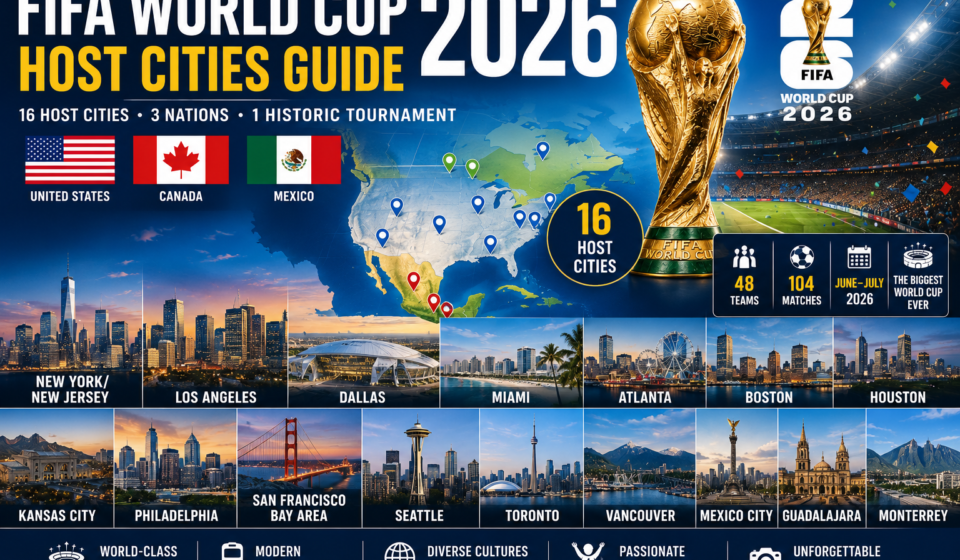

FIFA World Cup 2026 Host Cities Guide: Everything Fans Need to Know
Introduction
The FIFA World Cup 2026 is set to become the biggest tournament in football history. With 48 teams, 104 matches, and three host nations, fans will witness an unprecedented global spectacle spread across North America. While much attention has focused on the new tournament format and the star players expected to compete, the host cities themselves will play a crucial role in shaping the tournament experience.
For the first time ever, the FIFA World Cup will be jointly hosted by the United States, Canada, and Mexico. Sixteen host cities have been selected, each offering unique stadiums, football culture, and unforgettable experiences for traveling supporters.
Whether you’re planning a trip, following your favorite team, or looking for betting and fantasy football insights, this FIFA World Cup 2026 host cities guide covers everything you need to know.
Host Cities at a Glance
The FIFA World Cup 2026 will be played across 16 host cities:
United States
- Atlanta
- Boston
- Dallas
- Houston
- Kansas City
- Los Angeles
- Miami
- New York/New Jersey
- Philadelphia
- San Francisco Bay Area
- Seattle
Canada
- Toronto
- Vancouver
Mexico
- Mexico City
- Guadalajara
- Monterrey
The tournament’s geographic scale is unlike anything football has seen before, stretching from the Pacific Coast to the Atlantic Ocean.
United States Host Cities Taking Center Stage
The United States will host the majority of World Cup matches and will serve as the tournament’s operational backbone.
New York/New Jersey
MetLife Stadium is expected to host the FIFA World Cup 2026 Final. With a capacity exceeding 80,000 spectators, it is one of the most iconic sporting venues in North America.
For football fans, the city offers world-famous attractions, international cuisine, and an atmosphere unlike any other host destination.
Los Angeles
Los Angeles represents entertainment and sport on a grand scale. SoFi Stadium is among the most technologically advanced stadiums in the world and is expected to deliver a spectacular World Cup experience.
Dallas
AT&T Stadium is famous for its massive capacity and state-of-the-art facilities. Many experts believe Dallas could host some of the tournament’s most memorable knockout matches.
Miami
Miami’s multicultural environment makes it a natural football city. The strong Latin American influence ensures a vibrant atmosphere throughout the tournament.
Seattle
Known for passionate sports fans and impressive stadium architecture, Seattle is expected to provide one of the loudest environments during the competition.
Other U.S. Host Cities
- Atlanta
- Boston
- Houston
- Kansas City
- Philadelphia
- San Francisco Bay Area
Each city offers modern stadiums, extensive transportation networks, and a rich sports culture.
Canada’s Role in FIFA World Cup 2026
Canada continues to emerge as a growing football nation, and the World Cup provides a unique opportunity to showcase that progress.
Toronto
Toronto is Canada’s largest city and a diverse cultural hub. Matches played here will attract supporters from around the world.
The city has invested heavily in football infrastructure, and local enthusiasm has grown significantly following Canada’s qualification for recent major tournaments.
Vancouver
Vancouver combines stunning natural scenery with modern sporting facilities.
Located on Canada’s west coast, it provides a unique setting for World Cup matches and will likely become a favorite destination among international visitors.
The city’s football community has expanded rapidly, making it an ideal host for the world’s biggest sporting ev
Mexico’s Historic World Cup Legacy
No nation involved in the tournament has more World Cup hosting experience than Mexico.
Mexico will become the first country in history to host matches in three separate FIFA World Cups.
Mexico City
The legendary Estadio Azteca holds a special place in football history.
It hosted the 1970 World Cup Final, where Brazil and Pelé lifted the trophy, and the 1986 Final, where Diego Maradona inspired Argentina to glory.
For many football supporters, attending a match at Estadio Azteca is a bucket-list experience.
Guadalajara
Guadalajara has a deep football tradition and is home to some of Mexico’s most passionate supporters.
Expect packed stadiums, vibrant fan zones, and a true celebration of football culture.
Monterrey
Monterrey boasts some of the best football facilities in North America and is known for producing electric matchday atmospheres.
The city combines modern infrastructure with a strong football identity.
Which Host Cities Will Attract the Biggest Stars?
One of the biggest questions among fans concerns where the tournament’s elite players will perform.
By 2026, football supporters could potentially see stars such as Kylian Mbappé, Jude Bellingham, Erling Haaland, and a new generation of emerging talents competing across North America.
Major venues such as New York/New Jersey, Los Angeles, Dallas, and Mexico City are expected to host many of the tournament’s highest-profile fixtures.
For fantasy football enthusiasts and sports bettors, monitoring venue assignments can provide valuable insights regarding team performance, travel schedules, and environmental conditions.
What Makes These Host Cities Unique?
Every World Cup leaves a lasting legacy through its venues and host communities.
The FIFA World Cup 2026 host cities offer remarkable diversity:
- Coastal destinations like Miami and Vancouver
- Historic football locations such as Mexico City
- Entertainment capitals like Los Angeles
- Major business centers such as Toronto and New York
- Passionate sports markets including Kansas City and Seattle
This diversity creates an unmatched experience for traveling fans.
Unlike previous tournaments concentrated in one nation, supporters will experience multiple cultures, climates, and football traditions throughout the competition.
Key Statistics and Important Facts
- FIFA World Cup 2026 will feature 48 teams.
- A record 104 matches will be played.
- Three host countries: United States, Canada, and Mexico.
- Sixteen host cities selected.
- First World Cup hosted by three nations.
- Mexico becomes the first nation to host World Cup matches in three tournaments.
- Estadio Azteca remains one of football’s most historic venues.
- The tournament is expected to attract millions of international visitors.
Expert Analysis
The selection of host cities reflects FIFA’s ambition to create the most commercially successful and globally accessible World Cup ever.
From a sporting perspective, the wide geographic distribution presents unique challenges.
Teams will face varying climates, travel distances, and playing conditions. These factors could influence tactical decisions, squad rotation, and player recovery strategies.
For supporters, however, the diversity of locations is a major advantage.
Every city offers a distinct football experience, ensuring the tournament feels like a continent-wide celebration rather than a traditional sporting event.
Predictions and Future Outlook
Several host cities are likely to become defining symbols of FIFA World Cup 2026:
- New York/New Jersey could host the most-watched World Cup Final ever.
- Mexico City will deliver some of the tournament’s most emotional atmospheres.
- Miami may emerge as the fan-favorite destination.
- Los Angeles could host several blockbuster knockout matches.
- Toronto and Vancouver will further strengthen Canada’s football profile.
The success of these host cities may influence how future mega-events are organized across multiple countries.
Frequently Asked Questions
How many host cities are there in FIFA World Cup 2026?
There are 16 official host cities spread across the United States, Canada, and Mexico.
Which city will host the FIFA World Cup 2026 Final?
New York/New Jersey is expected to host the final at MetLife Stadium.
Which countries are hosting FIFA World Cup 2026?
The United States, Canada, and Mexico are co-hosting the tournament.
What is the most historic stadium in the tournament?
Estadio Azteca in Mexico City is widely regarded as the most historic venue because it hosted the 1970 and 1986 World Cup Finals.
Which host city is best for traveling fans?
Popular choices include Miami, Los Angeles, Mexico City, Toronto, and Vancouver due to their attractions, accessibility, and football culture.
Conclusion
The FIFA World Cup 2026 host cities are far more than locations on a map. They are the stages where football history will be written, legends will emerge, and millions of fans will gather to celebrate the world’s most popular sport.
From the iconic Estadio Azteca in Mexico City to the cutting-edge stadiums of the United States and the growing football centers of Canada, each destination offers something unique. As the countdown continues, these host cities are preparing to welcome the largest and most ambitious FIFA World Cup ever staged.
For football fans, bettors, fantasy managers, and travelers alike, understanding the host cities could be just as important as knowing the teams and players who will compete on the pitch.
Social Media Excerpt
The FIFA World Cup 2026 will span 16 host cities across three countries, making it the biggest tournament in football history. From New York and Los Angeles to Toronto and Mexico City, discover the stadiums, football culture, travel opportunities, and key insights every fan needs before the world’s biggest sporting event arrives in North America.